The Best Time to Take Your Vitamins (And Which Ones Not to Combine)
Some vitamins need fat to be absorbed, some need an empty stomach, and a few actively block each other. A practical guide to timing your supplements so you actually get what you're paying for.
Most people take their supplements the same way: everything at once, usually with breakfast, because that's the moment they remember. It's an entirely reasonable system — and for several common combinations, it's also the reason a good portion of what's in those capsules never makes it into your bloodstream.
Supplements are not all absorbed the same way. Some need dietary fat. Some need an acidic, empty stomach. And a few compete directly with each other for the same absorption pathway, so taking them together means each one gets less. Spacing them out costs nothing and is the difference between a supplement routine that works and an expensive habit.
Fat-Soluble vs Water-Soluble: The One Distinction That Matters
Nearly all timing advice comes down to this split.
Fat-soluble vitamins — A, D, E and K — dissolve in fat, not water. They need dietary fat present to be absorbed properly. Taken with black coffee on an empty stomach, a large share simply passes through. Taken with a meal containing some fat — eggs, nuts, dairy, oil, avocado — absorption improves substantially. Because your body stores these, consistency day to day matters more than the exact hour.
Water-soluble vitamins — the B group and vitamin C — dissolve in water and are absorbed readily without fat. Your body doesn't store meaningful amounts; the excess is excreted. That makes daily consistency important and the precise timing less so.
| Supplement | Best time | Why |
|---|---|---|
| Vitamin D | With the largest meal of the day | Fat-soluble — absorption rises sharply with dietary fat |
| Vitamin B12 and B-complex | Morning, with or without food | Water-soluble; may feel stimulating, so avoid late evening |
| Vitamin C | Any time; split doses absorb better than one large one | Water-soluble and not stored |
| Iron | Empty stomach, with vitamin C | Needs acidity; vitamin C markedly improves uptake |
| Calcium | With food, split into doses of 500mg or less | The body absorbs limited amounts at once |
| Magnesium | Evening | Often has a relaxing effect; commonly taken before bed |
| Omega-3 / fish oil | With a meal containing fat | Fat-soluble; also reduces the aftertaste and burping |
| Zinc | With food, away from iron and calcium | Can cause nausea alone; competes with other minerals |
The Combinations That Work Against Each Other
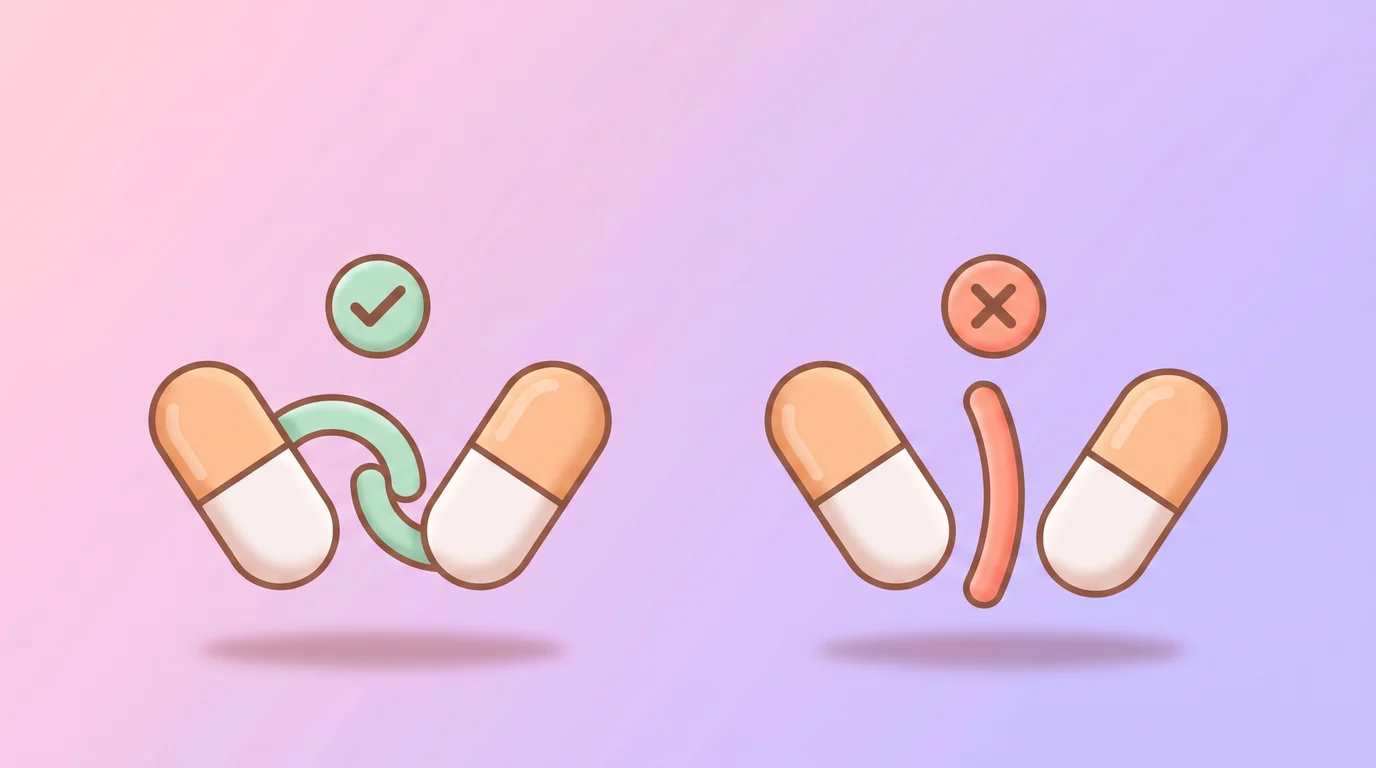
Minerals are the problem area. Several of them are absorbed through the same transport mechanism in the gut, so when they arrive together they compete — and the one present in the largest amount tends to win.
Keep these apart
- Calcium and iron — the best-known conflict. Calcium meaningfully reduces iron absorption. Separate them by at least two hours. If you're taking iron for a diagnosed deficiency, this one genuinely matters.
- Zinc and copper — sustained high-dose zinc can lead to copper deficiency over time. This is a reason not to self-prescribe high-dose zinc indefinitely.
- Zinc and iron — taken together in large doses they compete for absorption. Split them across the day.
- Calcium and magnesium — in large doses they compete somewhat. Many combined products account for this, but if you take both separately at high doses, space them out.
These help each other
- Iron and vitamin C — vitamin C converts iron into a form the body absorbs far more easily. Taking iron with a glass of orange juice is genuinely effective, not folk wisdom.
- Vitamin D and vitamin K2 — D increases calcium absorption; K2 helps direct that calcium to bone. They're often sold combined for this reason.
- Vitamin D and magnesium — magnesium is required for the enzymes that convert vitamin D into its active form.
Where Supplements Meet Prescriptions
This is the part most supplement guides omit, and it's the one with real consequences.
Calcium and iron don't only compete with each other. They also bind to several prescription medicines and reduce their absorption — most notably thyroid medication and certain antibiotics. Someone taking levothyroxine first thing and a calcium supplement with breakfast an hour later may be undermining their thyroid dose every single day without knowing it. The usual guidance is a gap of at least four hours.
Other interactions worth knowing: high-dose vitamin K can interfere with warfarin and similar blood thinners, and vitamin E in large doses may increase bleeding risk alongside them. St John's Wort, sold widely as a herbal supplement, interacts with a long list of prescription drugs including some antidepressants and oral contraceptives.
The rule that covers all of this: tell your doctor and pharmacist everything you take, including supplements. They are not inert simply because they're available without a prescription.
Making a Split Schedule Survivable
Reading the list above, the obvious problem appears: iron on an empty stomach, calcium with food but not near the iron, vitamin D with the biggest meal, magnesium at night, and a four-hour gap from the thyroid tablet. That is four or five separate moments in a day, and almost nobody sustains that from memory.
A workable pattern for most people looks like this:
- On waking — thyroid medication if prescribed, and iron if you take it, both on an empty stomach
- Breakfast, an hour later — B-complex and vitamin C
- Largest meal — vitamin D, omega-3, and any other fat-soluble vitamins
- Evening or bedtime — magnesium, and calcium if it's well clear of the iron
Four anchors, not four decisions. Set once, then repeated — which is the part where TextMyPill helps: Pillo sends each group on WhatsApp at its own time, so the split schedule runs itself instead of relying on you remembering which mineral blocks which.
Frequently Asked Questions
What is the best time to take vitamin D?
With your largest meal of the day. Vitamin D is fat-soluble, so absorption improves considerably when dietary fat is present. Taking it with black coffee or on an empty stomach wastes a meaningful portion of the dose. The specific time of day matters less than pairing it with food containing fat.
Can I take all my vitamins together?
You can, but you'll absorb less of some of them. The main conflicts are between minerals — calcium reduces iron absorption, and zinc competes with both. Fat-soluble vitamins also need a meal with fat. Splitting into two or three groups across the day is a meaningful improvement over taking everything at breakfast.
Which vitamins should not be taken together?
Keep calcium and iron at least two hours apart, as calcium substantially reduces iron absorption. Also separate zinc from both iron and copper in high doses. Conversely, iron and vitamin C work well together, as do vitamin D with K2 and magnesium.
Should I take vitamins on an empty stomach?
It depends on the vitamin. Iron absorbs best on an empty stomach with vitamin C. Fat-soluble vitamins — A, D, E, K and omega-3 — need food containing fat. Water-soluble B vitamins and vitamin C work either way, though some people find B vitamins cause nausea without food.
Can supplements interfere with my prescription medication?
Yes, and this is commonly underestimated. Calcium and iron bind to thyroid medication and some antibiotics, reducing their effect — a four-hour gap is usually advised. Vitamin K affects blood thinners, and St John's Wort interacts with many prescriptions. Always tell your doctor and pharmacist about every supplement you take.
Does it matter if I miss a day?
For fat-soluble vitamins your body stores, an occasional missed day has little effect. For water-soluble vitamins that aren't stored, and for iron being taken to correct a diagnosed deficiency, consistency matters much more — those are the ones worth setting a reminder for.
TextMyPill is an organizational reminder tool, not a medical professional, pharmacist or nutritionist. Supplement needs, doses and interactions vary by individual and by any medication you take. Speak to your doctor or pharmacist before starting a supplement, particularly if you take prescription medication or are pregnant.
Stop Forgetting. Start Pillo.
Set up free WhatsApp medication reminders in under 2 minutes.
Get Started Free →