Is It Safe to Take Expired Medicine?
The date on the strip isn't a cliff edge — but it isn't meaningless either. Here's what an expiry date actually guarantees, which medicines you should never risk, and why how you stored it matters more than the date.
Everyone has done the calculation. It's late, you have a headache, the only strip in the drawer expired four months ago, and the pharmacy is shut. Is it fine?
The honest answer is more interesting than a simple yes or no, because most people misunderstand what the printed date actually promises. It is not the moment a medicine turns harmful. But treating it as meaningless is equally wrong, and for a small group of medicines it's genuinely dangerous.
What an Expiry Date Actually Guarantees
An expiry date is a manufacturer's guarantee of potency and stability, not a poison warning. It means: stored correctly in its original packaging, this product will retain essentially its full labelled strength and remain chemically stable until this date. That's the whole claim.
Crucially, that date is derived from stability testing, and manufacturers rarely test further out than they need to. A drug given a two-year expiry may well be stable for longer — the company simply had no commercial reason to run a five-year study. This is why the date is a conservative floor, not a measured cliff.
What it does not tell you is what happened to that strip after it left the factory. Which, as it turns out, matters considerably more.
Storage Beats the Date
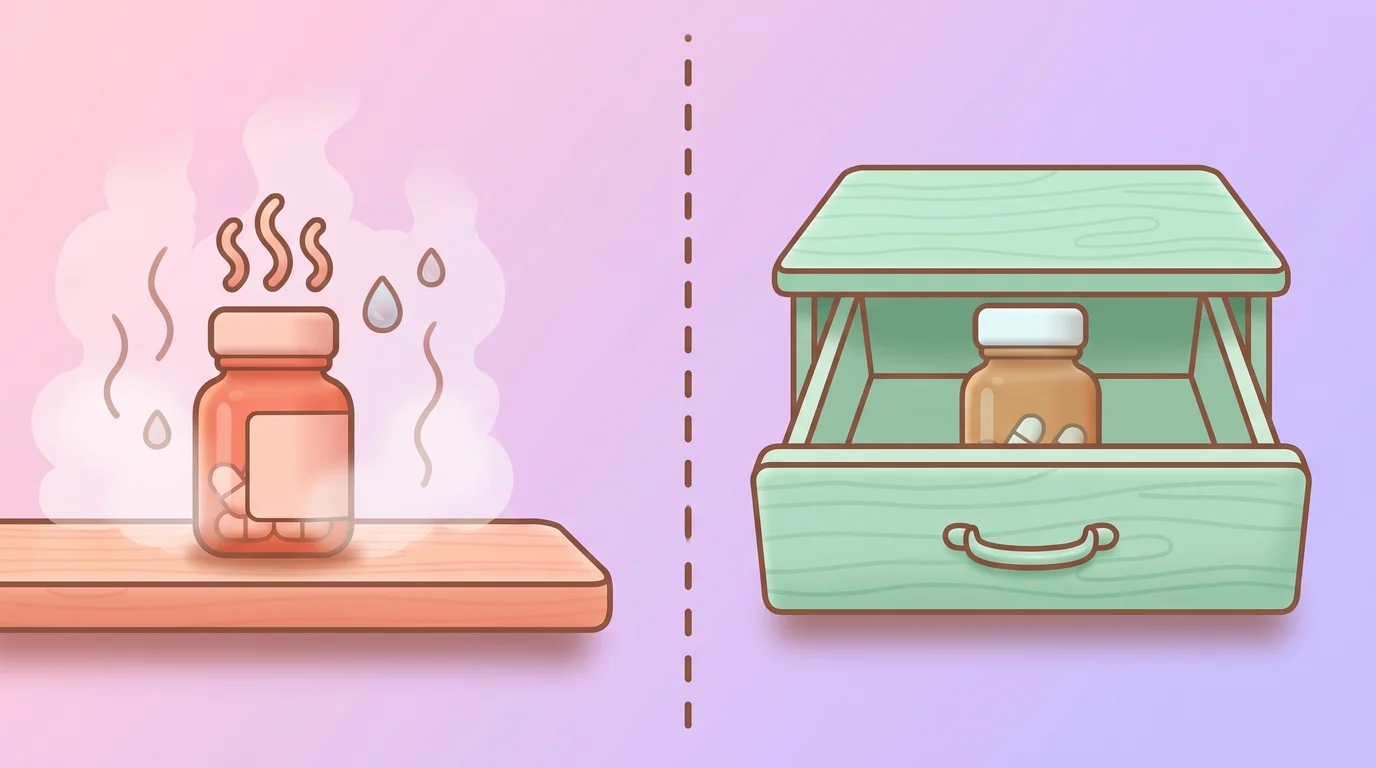
A tablet kept in a sealed strip in a cool, dry, dark drawer is in far better condition six months past its date than an identical tablet kept in a steamy bathroom cabinet that is still two months inside its date.
Heat, humidity and light all accelerate the chemical breakdown of medicines, and the bathroom — where an enormous number of households keep their medicine — is the single worst room for it. Every shower puts the cabinet through a heat and humidity cycle. A kitchen shelf above the stove is nearly as bad. India's climate makes this worse: sustained high temperatures and monsoon humidity degrade medicines faster than the temperate conditions most stability testing assumes.
So before considering the date at all, ask where it has been living. Then look at it:
- Discolouration — tablets that have yellowed, darkened or developed spots
- Crumbling, softening or stickiness — a tablet should be hard and intact
- An unusual or sharp smell — aspirin developing a vinegary smell is a classic sign of breakdown
- Cloudiness or separation in any liquid, syrup or suspension
- A cracked, punctured or previously opened blister
Any of these means discard it, regardless of what the date says.
The Medicines You Should Never Risk
For most everyday tablets, a slightly reduced potency is an inconvenience. For the following, reduced potency is the danger itself — because you are relying on full strength at the exact moment you need it.
| Medicine type | Why expiry matters more |
|---|---|
| Emergency medicines (adrenaline auto-injectors, asthma inhalers, angina sprays) | A weakened dose during an emergency can fail when there is no time for a second attempt |
| Insulin | Loses potency and is highly sensitive to temperature; under-dosing has immediate consequences |
| Antibiotics | A sub-potent course behaves like an incomplete one — the infection survives and resistance is encouraged |
| Nitroglycerin | Notoriously unstable and loses effectiveness quickly once the bottle is opened |
| Eye drops and any liquid | Preservatives degrade, allowing bacterial growth — a genuine infection risk, not just weakness |
| Anything for a serious chronic condition | Heart, seizure, thyroid and blood-thinning medicines depend on precise, consistent dosing |
The old fear that expired tablets become toxic is largely a myth, traced back to a small number of historical cases involving a degraded early formulation of tetracycline that is no longer in use. The realistic modern risk is not poisoning. It is a medicine that quietly does less than you think it is doing.
How to Dispose of Old Medicine Properly
Do not flush medicines down the toilet or sink — that puts pharmaceutical compounds into the water supply. Do not simply drop loose tablets in the household bin where a child or animal could find them.
The best option is to return them to a pharmacy, many of which accept unused medicines for safe disposal. Failing that, remove them from their packaging, mix them with something unappealing like used tea leaves or soil, seal that in a bag, and put it in the general waste. Scratch out any personal details on the label before discarding the box.
The Real Fix: Stop Accumulating Them
An expired-medicine drawer is a symptom. Strips build up because courses were left unfinished, doses were missed, or a prescription changed and the old one never left the house. The most reliable way to avoid the late-night decision is to not have a drawer full of half-used strips in the first place.
Two habits do most of the work: finish courses as prescribed, so nothing is left over, and check the drawer every six months rather than at the moment you urgently need something. A five-minute review twice a year turns an unknown pile into a known one.
For the first habit, TextMyPill sends WhatsApp reminders for each dose and follows up when one goes unanswered — so courses finish and strips empty. It won't tidy your drawer, but it stops it filling up.
Frequently Asked Questions
What happens if you take expired medicine?
In most cases, nothing dramatic — the main risk is reduced potency, meaning the medicine does less than expected. Expired tablets very rarely become toxic. The exception is medicines where full strength is essential, such as emergency medicines, insulin, antibiotics and eye drops, where an under-strength dose is itself the danger.
How long after the expiry date is medicine still good?
There's no universal answer, and no safe rule of thumb worth relying on. Stability varies enormously by drug and formulation, and storage conditions matter more than the elapsed time. For anything treating a serious condition, don't gamble — replace it.
Is it safe to take expired paracetamol or painkillers?
A recently expired, properly stored, undamaged tablet is unlikely to cause harm, but it may be less effective. Check for discolouration, crumbling or an unusual smell first — aspirin turning vinegary is a clear sign of breakdown. When in doubt, replace it; these are inexpensive and widely available.
Why shouldn't I store medicine in the bathroom?
Heat and humidity accelerate chemical breakdown, and a bathroom cycles through both every time someone showers. Despite the name, a bathroom medicine cabinet is close to the worst place in the house. A cool, dry, dark drawer or cupboard away from the kitchen stove is far better.
Does the expiry date change once I open the bottle?
Often, yes. Many liquids, eye drops and syrups carry a much shorter in-use period after opening — sometimes as little as four weeks — regardless of the printed expiry. Check the packaging or ask your pharmacist, and write the opening date on the bottle.
How should I dispose of expired medicines?
Return them to a pharmacy where possible. Don't flush them, as this contaminates water supplies. If you must bin them, remove them from packaging, mix with used tea leaves or soil, seal in a bag, and scratch out personal details on the label first.
TextMyPill is an organizational reminder tool, not a medical professional or pharmacist. This article is general information and not advice about any specific medicine. If you are unsure whether a medicine is still safe or effective, ask your pharmacist — it is a free question and they will answer it in under a minute.
Stop Forgetting. Start Pillo.
Set up free WhatsApp medication reminders in under 2 minutes.
Get Started Free →