Before Food or After Food? What Your Prescription Actually Means
"Take on an empty stomach" and "take after food" sound simple until you try to follow them exactly. Here's what each instruction really means, how long the gaps should be, and why some medicines stop working if you get it wrong.
Almost every prescription carries one of a handful of timing instructions: before food, after food, with food, or on an empty stomach. They're written as though everyone already knows what they mean. Most people don't — and the ones who ask usually get a vague answer.
How long before? Does a cup of tea count as food? Is "after food" five minutes later or an hour? Does it actually matter, or is it just something printed on every strip out of habit?
It matters more than most people realise, and not for the reason they assume. This isn't about politeness or tradition. Food changes how much of a drug your body actually absorbs, and for some medicines that difference is large enough to decide whether the prescription works at all.
The Four Instructions, Translated
Here is what each phrase generally means in practice. Your prescription always wins if it says something more specific.
| Instruction | What it means in practice | Why it's written that way |
|---|---|---|
| On an empty stomach | At least 1 hour before eating, or 2 hours after | Food blocks absorption of the drug |
| Before food | Roughly 30 minutes before a meal | The drug needs to act before food arrives |
| After food | Within about 30 minutes of finishing a meal | Food protects the stomach lining, or aids absorption |
| With food | During the meal itself | Fat in the meal is needed to absorb the drug |
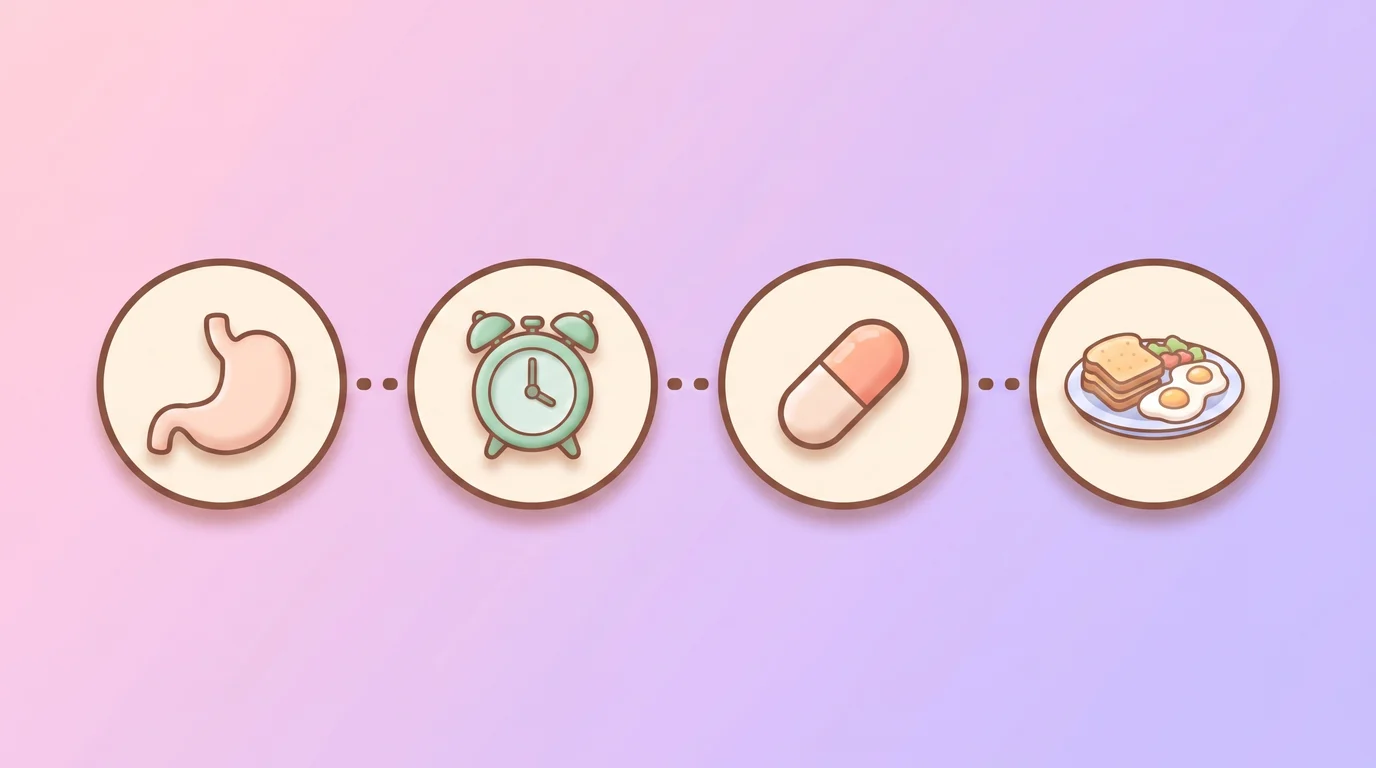
Why "Empty Stomach" Is the Strictest One
Of the four, this is the instruction people break most often and the one that punishes it hardest.
Certain drugs are absorbed in a narrow window in the upper small intestine, and they have to get there without competition. When food is present, some of the drug binds to it, some gets trapped, and some simply never crosses into the bloodstream. Thyroid medication is the classic example: taken with breakfast instead of well before it, absorption can drop substantially — enough to make blood tests look wrong and prompt a dose increase that was never actually needed.
Some antibiotics behave the same way. Calcium and iron in particular bind to certain antibiotics in the gut and form compounds the body cannot absorb, which is why a glass of milk or a morning supplement can quietly undercut a dose you took correctly in every other respect.
The practical version: if the instruction says empty stomach, aim for at least an hour before eating anything, or two hours after your last meal. Plain water is fine. Tea, coffee and milk are not — they count.
Why "After Food" Usually Isn't About Absorption
"After food" is often protective rather than pharmacological. Painkillers such as ibuprofen and diclofenac, steroids, and some iron supplements are known to irritate the stomach lining. Taking them on top of a meal puts a buffer between the drug and your stomach wall, which reduces the chance of pain, nausea and — over longer courses — more serious irritation.
Because of this, "after food" is generally more forgiving than "empty stomach." Being twenty minutes late is unlikely to matter much. Taking it on a completely empty stomach when the label said otherwise is what causes trouble, particularly with anti-inflammatory painkillers.
The One People Get Wrong Most: "With Food"
"With food" is not a softer version of "after food." For a small number of drugs — including some antifungals and certain HIV medications — the presence of fat in the meal is what allows the drug to dissolve and be absorbed at all. Taken with a plain cup of tea or a light snack, absorption can fall dramatically.
If your prescription says with food and the medicine is one where this matters, your pharmacist will usually tell you. If they didn't and you're unsure, it is worth one question at the counter: does this need a proper meal, or is any food fine?
What Counts as "Food"?
- Water — never counts as food. Safe at any point, and usually encouraged.
- Tea and coffee — count. Both can interfere with absorption independently of food, especially for thyroid medication and iron.
- Milk and dairy — count, and matter more than most foods because calcium binds to several drug classes.
- A biscuit or small snack — counts as food for "empty stomach" purposes, but usually isn't enough for a "with food" instruction that needs fat.
- Fruit juice — counts, and grapefruit juice in particular interacts with a long list of medications. Avoid it around any prescription unless you've checked.
When the Instructions Collide
The real difficulty starts when someone takes four or five medicines and the instructions contradict each other. One must be on an empty stomach, another with a full meal, a third twice a day, a fourth four hours away from calcium. Laid out on paper it looks unsolvable, and this is the point at which many people quietly give up and take everything together at breakfast.
It is almost always solvable, but it needs to be worked out once, deliberately, rather than improvised each morning. A workable approach:
- Anchor the strictest one first. The empty-stomach medicine gets the best slot — usually first thing on waking, with breakfast pushed back an hour.
- Build meals around it, not the other way round. Once the difficult dose has a fixed time, the with-food and after-food doses slot into meals easily.
- Separate the known binders. Calcium, iron and antacids need a gap of several hours from thyroid medication and certain antibiotics. Move them to a different part of the day entirely.
- Write it down once. A schedule you decided calmly beats one you reconstruct from memory while half-awake.
This is exactly the arrangement that's easy to design and hard to sustain. TextMyPill handles the sustaining part: photograph the prescriptions, and Pillo builds the daily schedule with each medicine at its own correct time, then sends the reminders on WhatsApp when each one is actually due — including the awkward pre-breakfast dose that's easiest to skip.
Frequently Asked Questions
How long before food should I take medicine?
For a "before food" instruction, roughly 30 minutes before eating is the usual guidance. For "empty stomach," the gap is longer — at least 1 hour before eating or 2 hours after your last meal. Your specific prescription may differ, so follow it if it gives an exact time.
Does tea or coffee count as food?
Yes, for timing purposes. Both can reduce absorption independently of food — coffee is well documented as interfering with thyroid medication, and tea contains compounds that bind to iron. If the instruction says empty stomach, plain water is the only safe thing in that window.
What happens if I take an empty-stomach medicine after food by mistake?
For one dose, usually nothing you'll notice — the concern is the pattern, not the single incident. Absorption for that dose may be reduced. Don't take a second dose to compensate. If it becomes a regular habit, tell your doctor, because it can make blood test results look misleading.
Can I take all my medicines together at one time?
Not without checking. Some drugs bind to each other in the stomach — calcium and iron are common culprits — and some need opposite conditions to work. Ask your pharmacist to review your full list together, including supplements, and tell you which ones must be separated.
Is "after food" the same as "with food"?
No. "After food" is usually about protecting your stomach from irritation, and is fairly forgiving. "With food" often means the drug needs fat from the meal to be absorbed properly, so taking it with only a light snack can meaningfully reduce how well it works.
Why does my prescription not say anything about food?
Many medicines genuinely aren't affected by food, so no instruction is needed. If a medicine is new to you and the label is silent, it's still worth asking the pharmacist — occasionally the instruction is verbal rather than printed.
TextMyPill is an organizational reminder tool, not a medical professional or pharmacist. The timings above are general guidance only. Food and timing instructions vary by drug, dose and individual, and your prescription and pharmacist's advice always take priority over anything in this article.
Stop Forgetting. Start Pillo.
Set up free WhatsApp medication reminders in under 2 minutes.
Get Started Free →