Recurring WhatsApp Messages for Pill Reminders
WhatsApp has no built-in recurring message feature. Here are the 4 workarounds people try, why most of them break, and the one reliable way to get daily automated pill reminders.

If you've searched for a way to schedule a WhatsApp message that repeats every day at 9 AM — a gentle "time for your blood pressure tablet" to your mum — you've probably discovered something frustrating: WhatsApp doesn't have a recurring message feature. Not in the regular app, not in WhatsApp Business.
That's the honest answer. But it isn't the end of the story, because there are ways to get a reliable daily reminder onto WhatsApp — some of them bad, one of them genuinely solid. This guide walks through all of them so you can pick without wasting a week on trial and error.
Why WhatsApp Has No Built-In Scheduled Messages
This surprises people, so it's worth explaining. WhatsApp is end-to-end encrypted, which means messages are encrypted on your device and only decrypted on the recipient's. For WhatsApp to send a message at 9 AM tomorrow, it would need to either keep your phone awake and scripted, or hold your message on a server in a readable form — which would undercut the encryption model the whole product is built on.
So there's no "schedule this message" button, and there's no "repeat daily" toggle. Any solution has to come from outside the app itself.
The 4 Workarounds People Try
1. Message Yourself + a Phone Alarm
WhatsApp lets you message your own number, so some people write the reminder to themselves and set a phone alarm to go check it.
Why it breaks: this is really just a phone alarm with extra steps — and crucially, it only works for you. It does nothing for an elderly parent in another city, which is the actual problem most people are trying to solve. There's also no record of whether the dose was actually taken.
2. Third-Party Scheduling Apps (SKEDit and similar)
Android apps like SKEDit use Accessibility permissions to physically tap the send button on your phone at a set time.
Why it breaks: several ways, and they're all quiet failures — which is the worst kind for medication.
- The reminder only sends if your phone is on, unlocked enough, charged, and online at that exact moment
- Android's battery optimisation regularly kills background automation without telling you
- WhatsApp UI updates break the automated tap, silently
- Automating taps through Accessibility services sits in a grey area of WhatsApp's terms — accounts have been restricted for automation-like behaviour
- Nothing comes back: no confirmation, no missed-dose alert, no history
A reminder system you can't trust to fire is arguably worse than none, because you stop double-checking.
3. WhatsApp Business Away & Greeting Messages
WhatsApp Business has automated greeting and away messages, so people assume these can be repurposed.
Why it breaks: these are reactive, not scheduled. They only fire when someone messages you first. You can't use them to initiate a 9 AM reminder.
4. Just Doing It Manually
Plenty of families do exactly this — an adult child texts their parent every morning.
Why it breaks: not technically, but humanly. You'll forget on the days you're busiest, and it slowly turns into the dynamic nobody wants: a parent who feels nagged, and a child who feels like a supervisor. That relationship cost is the real reason people look for automation in the first place.
The One Approach That Actually Works: The Official Meta Cloud API
There's a legitimate path, and it's the one businesses use to send you order updates and OTPs: the official WhatsApp Business Platform (Meta Cloud API).
Instead of automating taps on your phone, the message is sent from Meta's own servers to the recipient. That changes everything that made the workarounds fragile:
- It doesn't matter whether your phone is on, charged, or in another timezone
- It's fully sanctioned by Meta — no terms-of-service grey area, no risk to anyone's account
- Messages can be sent to someone else, at their local time
- Replies come back, so a "Done" can actually be recorded
The catch is that you can't set this up casually — it requires a verified business account, approved message templates, and developer work. Which is why the practical route for a family is to use a service built on top of it.
How to Set It Up in About Two Minutes
TextMyPill is built on the official Meta Cloud API specifically for medication schedules. Here's the whole flow:
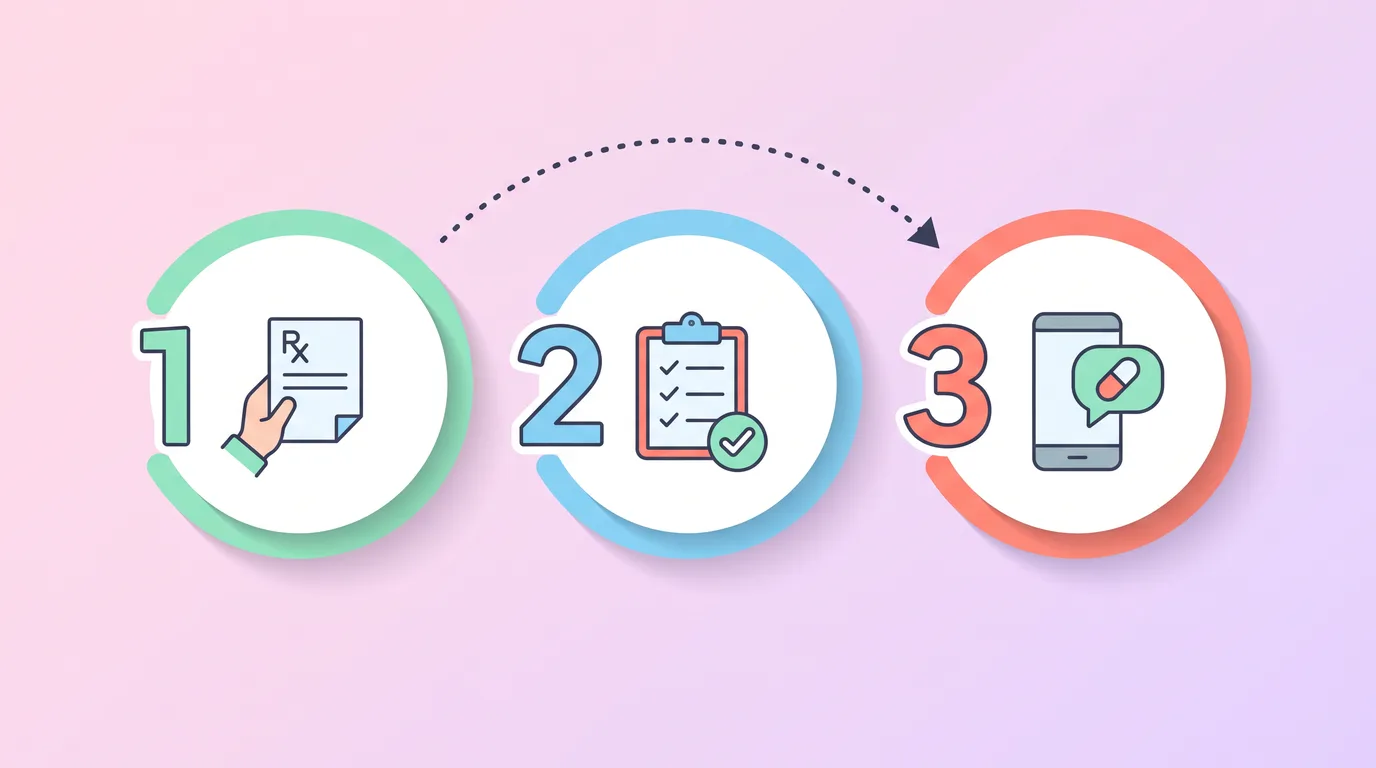
- Upload the prescription. Take a photo of the prescription or the pill boxes. The AI reads the medicine names, doses, and timings.
- Review the schedule. You check what it extracted and correct anything before it goes live — a human always approves the schedule. Set meal times so "after breakfast" maps to when they actually eat.
- Reminders start. Pillo sends a friendly WhatsApp message at each dose time. They reply "Done" to log it. If there's no reply, it follows up — and if there's still nothing, you get an alert.
You do all of this from a web dashboard, wherever you live. Your parent installs nothing and learns nothing new — the reminder lands in the same app as their family group chats, and can arrive in English, Hindi, or Marathi.
Side-by-Side Comparison
| Method | Truly recurring? | Works if your phone is off | Can remind someone else | Logs the dose |
|---|---|---|---|---|
| Message yourself + alarm | ❌ Manual | ❌ | ❌ | ❌ |
| Scheduling apps (SKEDit) | ⚠️ Unreliable | ❌ | ⚠️ Fragile | ❌ |
| Business away messages | ❌ Reactive only | — | ❌ | ❌ |
| Texting manually | ❌ Depends on you | ❌ | ✅ | ❌ |
| Meta Cloud API service | ✅ | ✅ | ✅ | ✅ |
Which One Should You Pick?
If you're reminding yourself and you're comfortable with a plain alarm, honestly — use the alarm. You don't need WhatsApp for that.
But the moment the reminder is for someone else — a parent, a grandparent, a spouse recovering from surgery — the phone-automation workarounds fall apart, because they all depend on your device being awake at the right second. That's when a server-side service is the only thing that holds up day after day.
And the daily reliability is the whole point. Missing occasional doses measurably reduces how well a treatment works, and for chronic conditions the gap compounds quietly over months.
You can set up TextMyPill free and have the first reminder going out today. If you're weighing it against hardware, we've also compared it honestly with smart pill dispensers and with standalone medicine apps.
Frequently Asked Questions
Can I set daily recurring messages on WhatsApp?
Not natively — WhatsApp has no built-in feature to schedule or repeat messages, in either the standard or Business app. Recurring daily messages are only possible through the official WhatsApp Business Platform (Meta Cloud API), which services like TextMyPill use to send scheduled medication reminders from a server rather than from your phone.
Is there a WhatsApp bot for medication reminders?
Yes. TextMyPill is a WhatsApp reminder assistant that reads a photo of a prescription, builds the dose schedule after you approve it, and sends daily interactive reminders. The recipient replies "Done" to log each dose, and no app download is required on their side.
Are apps like SKEDit safe to use for WhatsApp reminders?
They work occasionally but aren't dependable for medication. They rely on Accessibility permissions to tap send on your own phone, so they fail whenever your device is off, offline, or battery-optimised, and they break when WhatsApp updates its interface. Automation of this kind also sits in a grey area of WhatsApp's terms of service. For something as consequential as a dose, a server-side service on the official API is the safer choice.
Can I send automatic WhatsApp reminders to my parents in another country?
Yes — this is where server-based reminders have a clear advantage. Because the message is sent from Meta's servers rather than your handset, your own phone can be off or in a completely different timezone. You set the schedule from a web dashboard, reminders arrive at your parent's local meal times, and you're alerted if a dose goes unconfirmed.
Does my parent need to install anything?
No. That's the main reason WhatsApp works so well for this age group — the reminder arrives in the app they already open every day, next to messages from family. There's no new app, no new login, and no new interface to learn. Replying "Done" is the entire interaction.
TextMyPill is an organizational reminder tool, not a medical professional. Always verify medication details and timings with your doctor or pharmacist.
Stop Forgetting. Start Pillo.
Set up free WhatsApp medication reminders in under 2 minutes.
Get Started Free →